SpectralEqualizer Node
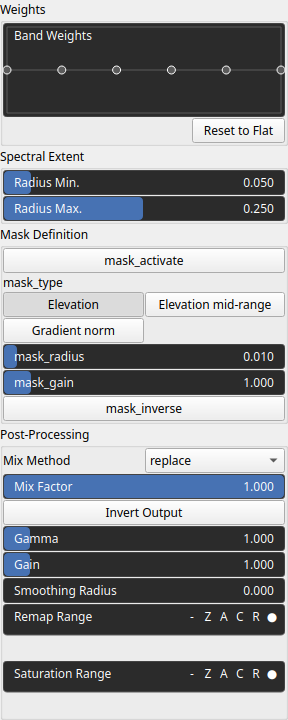
Adjusts the frequency content of the input field by decomposing it into multiple scales and reweighting each frequency band independently. This allows fine control over large structures, medium features, and fine details.
Category
Filter
Inputs
| Name | Type | Description |
|---|---|---|
| input | VirtualArray | Input field to be processed. |
| mask | VirtualArray | Optional mask controlling where the effect is applied. |
Outputs
| Name | Type | Description |
|---|---|---|
| output | VirtualArray | Output field with adjusted spectral content. |
Parameters
| Name | Type | Description |
|---|---|---|
| Band Weights | Vector of floats | Weight of frequency bands. |
| mask_activate | Bool | Enables or disables the internal mask. If the node's 'mask' input is connected, this setting is bypassed and the input mask is used instead. |
| mask_gain | Float | Controls the intensity or influence of the internal mask. Bypassed if the 'mask' input is connected. |
| mask_inverse | Bool | Inverts the internal mask, applying the operator where the mask is low. Ignored if a 'mask' input is provided. |
| mask_radius | Float | Defines the smoothing radius for the internal mask. A value of 0 disables smoothing. This is bypassed if the 'mask' input is used. |
| mask_type | Choice | Specifies how the internal mask is computed: 'Elevation' uses height, 'Gradient Norm' uses slope, and 'Elevation mid-range' selects the middle portion of the height range. This parameter is ignored when a 'mask' input is connected. |
| Gain | Float | Mid-centered gain transformation applied to the elevation values. This is a non-linear recurve operator centered around the mid elevation (typically 0.5). Increasing the gain pushes values toward the minimum and maximum elevations, creating flatter low/high regions with a steeper transition around the midpoint. |
| Gamma | Float | Standard gamma correction applied to the elevation values. This is a monotonic power-law remapping that shifts emphasis toward low or high elevations, making the overall shape sharper or bulkier without changing its ordering. |
| Invert Output | Bool | Inverts the output values after processing, flipping low and high values across the midrange. |
| Mix Factor | Float | Mixing factor for blending input and output values. A value of 0 uses only the input, 1 uses only the output, and intermediate values perform a linear interpolation. |
| Mix Method | Enumeration | Method used to combine input and output values. Options include linear interpolation (default), min, max, smooth min, smooth max, add, and subtract. |
| Remap Range | Value range | Linearly remaps the output values to a specified target range (default is [0, 1]). |
| Saturation Range | Value range | Modifies the amplitude of elevations by first clamping them to a given interval and then scaling them so that the restricted interval matches the original input range. This enhances contrast in elevation variations while maintaining overall structure. |
| Smoothing Radius | Float | Defines the radius for post-processing smoothing, determining the size of the neighborhood used to average local values and reduce high-frequency detail. A radius of 0 disables smoothing. |
| Radius Max. | Float | Maximum smoothing radius defining the lowest frequency band. Controls large-scale structures. |
| Radius Min. | Float | Minimum smoothing radius defining the highest frequency band. Controls fine details. |
Example
No example yet
No example available for this node.